
Maxwell’s Equation
Interviewee: Chris Doran, University of Cambridge
Your talk mostly involved calculus and the geometric way of approaching it. You said it would be challenging for you to condense the talk to one hour, but I would like to make an even more impossible request. Can you please give a brief overview right now?
Multidimensional calculus is a well-established branch of mathematics. It usually takes 2 or 3 lectures to get all the details across. I tried seeing if I can get enough shortcuts to cover the key points, and hopefully do it in a way that the people who go into this and try implementing something that I talked about in code have enough information to try it out themselves.
Can you please provide an example of how it is possible to take a derivative of a geometric object and what the result represents geometrically?
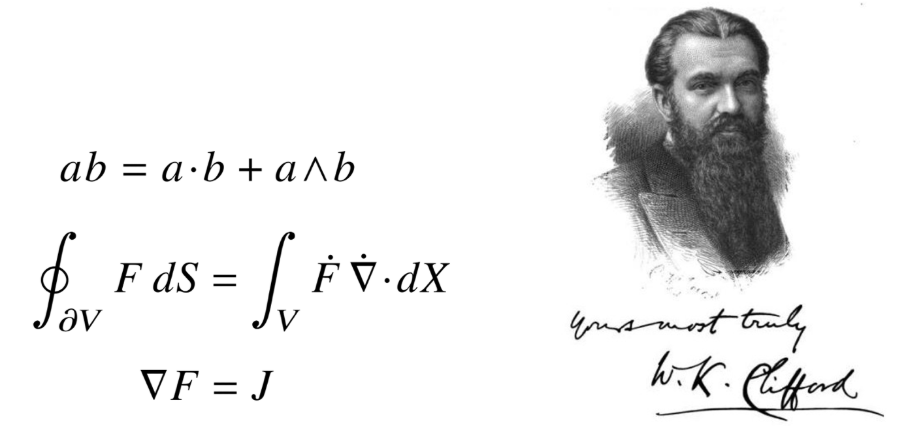
I was mostly talking about fields. A simple example might be a temperature; every point has it. A vector derivative will give the direction in which the temperature is increasing most rapidly. It starts getting a bit more abstract if one starts differentiating more complex geometry, like vector, electric, or magnetic fields. There are some new operators coming out, which also take time to cover. Geometric Algebra gives a neater approach to this. Thus, making it also possible to squeeze it into one hour.
In the past, you also founded a company, Geomerics. You developed a real-time global illumination solution, Enlighten. Did you use any Geometric Algebra in it?
We did a bit early on. Particularly in the theoretical kind of work. Ultimately, when one writes code for a computer, all one can do is tell it to add some numbers, multiply them together, and so on. In this context, it does not mean much to say it was doing Geometric Algebra. The real value that we put into it was less on the geometry side and more on compressing data down to a certain tiny amount, so that we can fit into the memory budget of the PlayStation 3, for example, and still do complicated lighting calculations at runtime.
You also wrote a PhD on Geometric Algebra; can you please tell us more about it?
I think a lot of the aspects that were commenced in my PhD are what I carried on doing throughout my research career. Not that many people did their PhDs in Geometric Algebra at that point, so I was probably one of the first to cover a broad amount of physics in the GA way.
Has the number of people taking a PhD in Geometric Algebra increased over time?
There were some peaks and drops, but generally not quite many. These days, I quite often get people asking me if they can do their PhD in Geometric Algebra. And I generally tell them that this is the wrong way to think about the PhD. One must find a problem they want to work on; if Geometric Algebra can provide a proper approach to that problem, then they should absolutely use it. As for doing research on Geometric Algebra for its own sake, there is enough of that. We need to push more heavily on the applications. Otherwise, we talk about how smart our field is without using it.
Can you provide examples of applications where GA was not used enough yet?
A significant one at the moment is machine learning (ML), where GA is starting to find its way into various neural network architectures. Various people, for instance, a research group from Amsterdam, reported promising results and founded a spin-out company based on their ideas. There is a long-standing debate on whether ML models should have any preconditions defined in them or not, yet lately, researchers are finding out that networks that have, for instance, quaternions or GA baked in, learn faster when applied to geometric problems, giving the ability to get away with much smaller networks. ML is also one of the main channels through which new researchers are coming into GA. Particularly in China, there are a lot of them.
What is the GA project you are the proudest of?
I work on the GA approach to gauge theory; gravity is something I’m the proudest of. Specifically, a version of the momentum kernel metric calculation that I found. Something that was two pages of algebra got down to one simple line.
What areas of GA do you think are yet to pioneer?
I think the area that not so many people pushed on is seeing how different equations from complex analysis are expressed in GA and seeing how each of these equations is generalised to higher dimensions. There is a rich function theory to be developed there, but today, very little progress has been made. I’m also interested in discrete ways of solving equations, discretisation, and differential equations, as well. We will hopefully see some GA progress being made there.
Discretisation brings me to graphics rendering for games. Do you think GA has a future in this field, as well?
Yes, games already use bits of GA inside typical game engines. Quaternions are a key component of any physics solver. We’ll never go back to the matrix way of doing rigid body dynamics; it is too slow and inaccurate. Dual quaternions are used in skinning. Many developers come across these different bits of GA but never dive fully into it. Potentially because of a lack of time. Nonetheless, we need a critical mass of people who will take the time to learn the maths properly and start applying it to more advanced techniques.
How do you think we can encourage people to become this critical mass that is going to actively incorporate GA in their work?
They need some hero examples, where GA solved a problem that many developers struggled with a lot. Without that, the motivation that really drives one to investigate the subject will usually not be sufficient.
Thank you for having this conversation, and good luck with your work!
Human interest interview conducted by Maxime Arnolis
Technical interview conducted by Aleksandrs Stukalovs