
Interviewee: David Eelbode, Universiteit Antwerpen
When dealing with chaotic and intensive calculations, given the nature of quantum mechanics, is Geometric Algebra an alternative, or a necessary tool for you that allows you to be more efficient?
I often think about this myself. What I have told you today is an alternative to an existing framework, so some might say that it is useless. However, I think that geometric algebra can, and that would be important for people here, speed up things. That I think is a practical purpose that justifies its usage. Especially for you, game designers and developers. If it goes quicker and cheaper – it is better. For particle physics, one of the things that we wish to achieve is also speeding up calculations, a practical purpose again.
The question is whether there is value in the theoretical side of the story. I would say yes. For instance, being able to explain difficult things, starting from a concept of mirrors, which everyone has at home – is a giant leap. I think in that lies the power value of Geometric Algebra.
Knowing that Geometric Algebra is such a different framework that also was not generally supported by the mass-produced hardware, would you think the switch from Linear to Geometric Algebra is such a change that most people would not agree to, since they are used to Linear Algebra?
I am a theoretical scientist, so regarding hardware I have absolutely no idea. Nevertheless, deep down Geometric Algebra is an alternative for Linear Algebra. There are a lot of examples, where a thing in Linear Algebra, when looked at from Geometric Algebra perspective contains more details, which you could separate. It is like looking at a spaghetti sauce in a pot, and at ingredients that were used to cook it. You can not change the sauce once it is cooked, that is the pot with matrix sauce. But you can remove certain ingredients and cook it however you like once you have the GA at your disposal. I think that is where the value lies in a switch from one to the other.
You usually use the simplest of Geometric Algebras, but do you think there are applications for Projective Geometric Algebra and Conformal Geometric Algebra for quantum mechanics?
There are definitely matches for Projective Geometric Algebra. In my talk and other talks, calculations and rotations were set around the origin. However, in nature we would like to describe, for instance, curved things, for which you would have to replace a framework. As soon as we would want to go from centred around the origin to centred around different points, PGA would come into play. Regarding CGA, that would be mainly the change of signature.
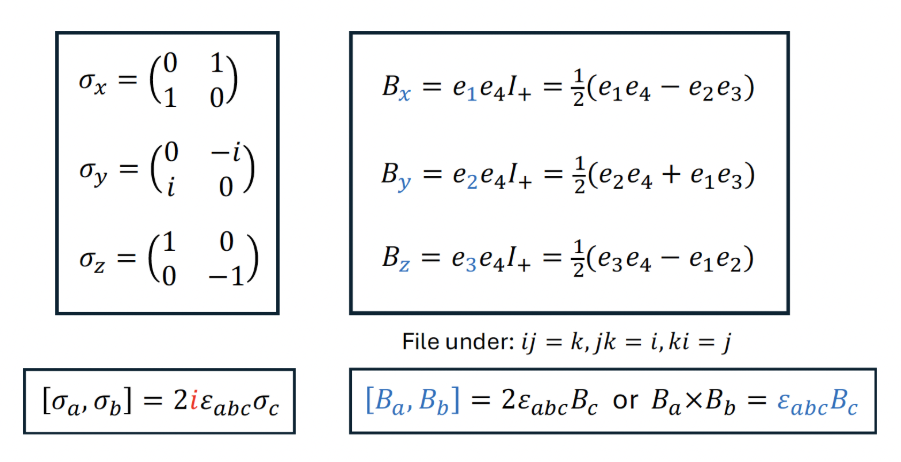
The four-dimensional orthogonal planes, how do they relate if they do not intersect in a line?
A very nice way to think about two planes that only have one point in common, is core of the lecture of Martin Roelfs. He says to imagine looking at a line, that due to the edge-on view did not reveal itself being a plane. A line that intersects a plane has only one point in common, but now imagine that this line is in fact a plane. To see it, it would have to be rotated into the 4th dimension.
You have shown us formulations with GA that help you in quantum mechanics. Do you know whether GA could provide any aid in terms of quantum computing?
The lecture was specifically designed to be an introduction, but I think for sure this framework can be translated into the world of quantum computing. Because essentially quantum computing is just the next phase of the story. The question is whether it will provide improvements. Either practical, or insight-wise, from looking at it from a new perspective. I don’t know what it would be. There is at least an opportunity, but apart from that, that is the question for the future.
Well, best wishes for further progress on this by GAME29!
Interview conducted by Maxime Arnolis, Leendert Desmet and Bas Feitsma