
A geometric tour de force
Interviewee: Anthony Lasenby, Kavli Institute for Cosmology and Cavendish Laboratory, University of Cambridge
Physics has four fundamental forces — gravity, electromagnetism, and the weak and strong nuclear forces — and one of the deepest questions in modern science is why Nature chose the particular mathematical symmetries that govern them. At the GAME2026 meeting in Kortrijk, you presented new progress in a long-running personal programme that seeks to answer this question using the language of Geometric Algebra – why in Geometric Algebra?
As demonstrated in several talks in the meeting, Geometric Algebra is a powerful generalisation of ordinary vector algebra in which geometrical objects of different dimensions — points, lines, areas, volumes — can all be combined and manipulated within a single consistent framework. Its particular advantage for physics is that the four-dimensional geometry of spacetime itself, with its characteristic distinction between time and space directions, generates an algebra known as the Spacetime Algebra (STA). Rather than importing mathematical structures from outside — matrices, complex numbers, quaternions, spinors — the STA produces all of these naturally from the geometry of the universe we actually inhabit. The STA has long been known to provide elegant formulations of electromagnetism, quantum mechanics, and gravity. The talk’s ambition was to show that it also contains the seeds of the full symmetry structure of the Standard Model of particle physics.
We can imagine you need to unravel such step by step?
The route described into the nuclear forces runs through a remarkable family of mathematical objects called the octonions. Alongside the real numbers, complex numbers, and quaternions, octonions form the last member of a unique family: there are exactly four number systems in which division is always possible and the norm of a product equals the product of norms. The octonions are eight-dimensional and, unlike all familiar number systems, they are non-associative: the order in which you perform a sequence of multiplications genuinely matters. Despite this strangeness — or rather because of it — octonions encode an exceptional richness of symmetry structure. Their multiplication table can be beautifully visualised through a classical figure from projective geometry called the Fano plane, in which seven points and seven lines each carry an octonionic unit.
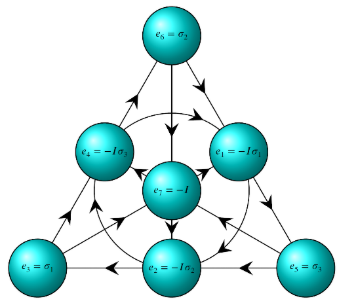
A key insight of this research programme is that the seven imaginary octonionic units can be identified directly with specific elements of the STA — bivectors and other geometric objects built from the spacetime vectors — so that all octonionic arithmetic can be performed within the framework of geometric products already familiar from the rest of the physics.
Figure: the Fano plane (courtesy of Anthony Lasenby)
How do these fancy octonions relate to the four fundamental forces?
The fundamental forces of the Standard Model are governed by symmetry groups: SU(3) for the strong force that binds quarks into protons and neutrons, SU(2) for the weak force responsible for radioactive decay, and U(1) for electromagnetism. A long-standing mystery is why Nature selected this particular combination. Earlier work, reported at a previous GAME meeting (https://tinyurl.com/Anthony-Lasenby-at-GAME23 ), had shown how chains of octonionic operations generate a 64-dimensional algebraic structure that contains the SU(3) symmetry of the strong force and can potentially accommodate three generations of matter particles — the familiar electron, muon and tau families and the three sets of quarks (up/down, charmed/strange and top/bottom).
I recall you presenting this back in 2023 … do we sense a sequel here?
Each particle comes in two mirror-image forms called left-handed and right-handed states, which are treated completely differently by the weak force. Accommodating all of this requires a larger algebraic space, and the new material presented at GAME2026 takes a substantial further step in this direction. The talk showed that extending from the octonions to their 16-dimensional cousins, the sedenions, and working within the corresponding 256-dimensional algebra, provides exactly the room needed. A particular mathematical construction — a spin module within the algebra — yields a 16×16 matrix in which all the known matter particles and their antiparticles, across all three generations, and for both left-handed and right-handed forms, find a natural home: quarks in three colours, leptons, neutrinos, the Higgs field, all arranged in a single structure.
That makes it a compelling extension!
The most striking result is that the symmetry groups of the Standard Model emerge from the geometry of this construction without being put in by hand. By examining which transformations leave certain rows of the particle matrix unchanged, one recovers first the exceptional group G₂ (the symmetry group of the octonions), then SU(3), and then SU(2), in a natural chain of subgroups — each group arising as more and more of the particle spectrum is required to be unaffected. The U(1) symmetry that leads to electromagnetism follows as the set of transformations commuting with both SU(3) and SU(2), and the charges it assigns to each particle — the weak hypercharges — reproduce the correct Standard Model values with only two free parameters, fixed by simple normalisation choices. The formula relating electric charge to weak hypercharge and weak isospin, one of the empirical pillars of the Standard Model, then falls into place automatically.
A further prediction of the framework deserves mention: the construction requires the existence of right-handed neutrinos — one for each generation — that couple to nothing except gravity, making them natural candidates for the dark matter whose gravitational effects are observed throughout the cosmos, but whose identity remains unknown.
Which brings us back to my opening question: why per se in Geometric Algebra?
Some other approaches to the symmetries of the Standard Model based on octonions, higher dimensional Clifford algebras, or just pure matrices, have also had recent successes in seeking to explain the particles and their forces. However, the approach presented here is notable for working entirely within the four dimensions of ordinary spacetime, with no appeal to extra dimensions or exotic new geometry. Everything described — from the Dirac equation for the electron to the colour charges of quarks — emerges from the algebra of the space and time we inhabit. Whether this line of mathematics ultimately connects to a complete theory of all the forces, including a full treatment of Lorentz Symmetry and the dynamics of the interactions themselves, remains the subject of ongoing work. But the deep alignments between the STA, the structure of octonionic and sedenionic algebra and the observed symmetries of particle physics grow steadily more compelling.
Well, best wishes for further progress on this by GAME29!
Interview conducted by Maxime Arnolis