
Geometric Dynamics
Interviewee: Leo Dorst, University of Amsterdam
You have shown us benefits that Geometric Algebra (GA) can provide for classical motion. Have you investigated its benefits in relativistic motion? Does it have a viable potential there?
I have not, but I have found that as I go into conventional motion, I get into the same algebra that is used for relativistic motion. Martin Roelfs is developing this STAP algebra (with Anthony Lasenby), and we compare our discoveries.
You have said that you were doing robotics. Is GA providing a viable performance for this sphere with current hardware, which is more suited to perform Linear Algebra calculations?
It unifies certain frameworks, rather than having to compute separately and combine afterwards. When you have the right compiler, and Steven De Keninck wrote a few, you get coordinate code that manipulates numbers as efficiently as Linear Algebra. If current hardware supports quaternions, you can use it to accelerate things that are already fast in Linear Algebra, avoiding doing multiple operations, but rather doing just one.
Is Geometric Algebra faster computationally than Linear Algebra?
In Linear Algebra to combine two rotation matrices, you must define them and then combine them, which is expensive. It is more advantageous to go into quaternions and multiply those quaternions to later turn the result into a rotation matrix and put that onto your graphics card.
There are certain things that are more efficiently done in GA for at least a part of your pipeline. But it is not immediately faster or less fast in all circumstances, you must be smart about how you use it.
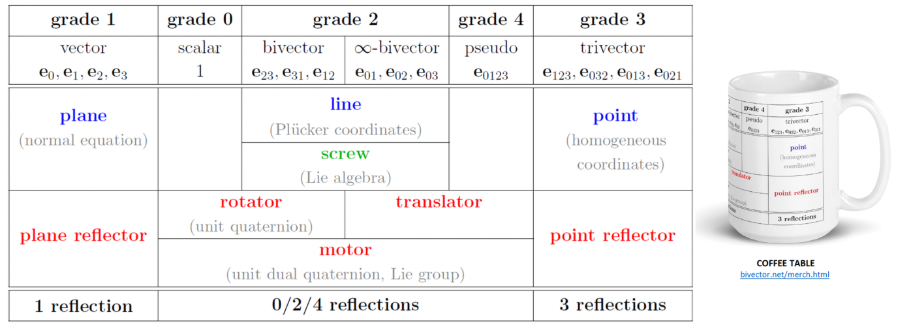
Do you think hardware design could change in the future for GA’s benefit?
A while ago, NVIDIA contacted me asking whether they should put the geometric product into their processors. Now that we understand better what the connection is with the geometric product and using quaternion hardware, it might go that way, rather than developing a special processor. But if it gains attention, then companies will follow. There are now Geometric Algebra neural networks that are very effective for certain geometrical problems. If there are a lot of these problems, of course you would want a processor that is designed to use it efficiently.
Could you explain what a sandwich product is in GA?
If you do Linear Algebra, you have an operator, a matrix for example, that applies to a vector. If you need a line, you will have to use two vectors in 6-dimensional coordinates. You would have to design a new matrix to process that, with additional code, where you can make mistakes that are hard and tiresome to identify. Sandwiching makes the transformation universal, which means much less code, due to it being able to transform everything with one kind of operator, without a need to design a new one.
It is a structural preservation property, which is a huge benefit for code. You can still generate the Linear Algebra code, but with GA you can do it from a higher level that is less error-prone at very least.

Well, best wishes for further progress on this by GAME29!
Interview conducted by Leendert Desmet